Catherine Dormor
Collecting and Holding Emptiness
Xawery Wolski’s chains, tangles and gouging
This essay was commissioned by the Lodz Museum of Textiles as part of Xawery Wolski’s solo exhibition, ‘Tangles’ (November 2023- April 2024). The author wants to thank Xawery, Jaroslaw and Isabella for their kind hospitality both in Warsaw and at Wolski’s estate at Dańków. Their time and open-hearted generosity is intertwined in this essay necessarily as it frames a particular approach for thinking through and with Wolski’s work.
Introduction — Collecting Emptiness
One might, quite reasonably, ask what it means to collect emptiness, and it would be quite reasonable to think that to speak of an artist’s work in these terms might not be considered a positive set of reflections. However, in this essay, I want to point towards some of the ephemeral aspects of Xawery Wolski’s work. I wanted to speak into and with its robust materiality through its holes, gaps and spaces. These gaps and spaces are formed by wire, loops, the hand and the worm, meaning that each is a repeated act that builds and amasses form incrementally, slowly and methodically.
The essay will be formed around three themes: chains, tangles and gouging, drawing on the collection of knitted wire sculptures, Pneuma – Air and Spirit (2011, Museo Diego Rivera Anahuacilli, Mexico City), the Tangles and Knots series (2009 to date) as points of departure. Where knitting and looping offer pliability, flexibility and mutability, creating temporary and contingent emptiness, gouging approaches emptiness as a form of emptying out, removal of unwanted material. I do not propose that these are antitheses of one another, this is not a binary situation. Rather, it is a complementary and supplementary set of relationships in which holding emptiness rejects inclusive-exclusive thinking and processes in favour of thinking and making through networks, connectivity, intra-activity and inter-relationality. This is, necessarily, an imaginative and speculative set of spaces and sites of activity.
The links and chains I want to explore here are not the heavy chains and links that typify Wolski’s oeuvre and have become a form of signature, but to consider the knitted wire forms as a strand of thinking about community and connectivity. In this I will draw on Karen Barad’s concept of intra-action as a means by which to consider agential interplay between elements (here loops that are built upon loops that support loops). This then becomes a site of exchange between and within communities, establishing an open and porous network. Edges of things, processes and systems, both human and beyond human become one site that is considered here through the lens of Gayatri Spivak who speaks about what happens to meaning-making at the frayed edges of language. This is useful here as we consider the contingency and intra-dependability of these looping structures.
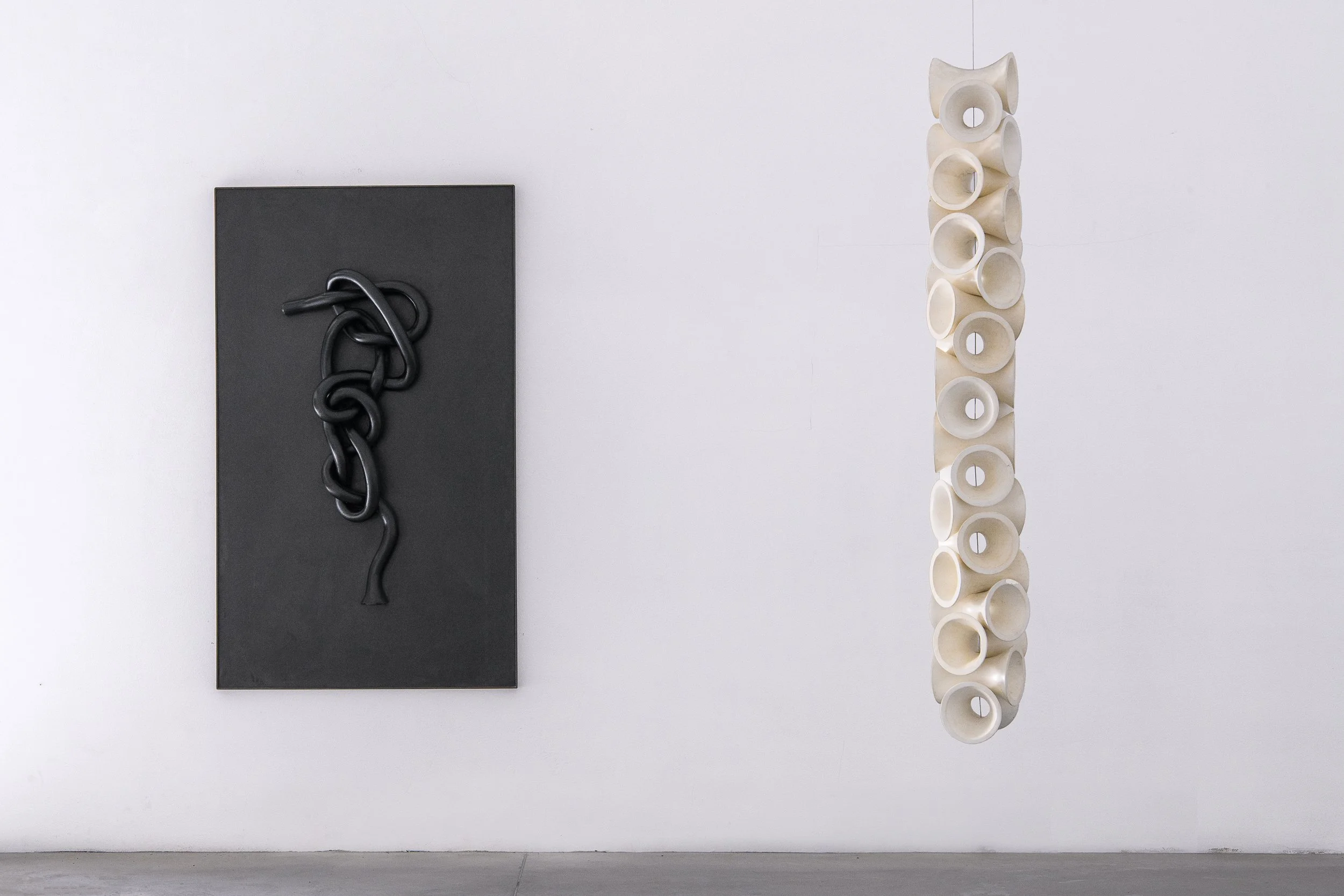
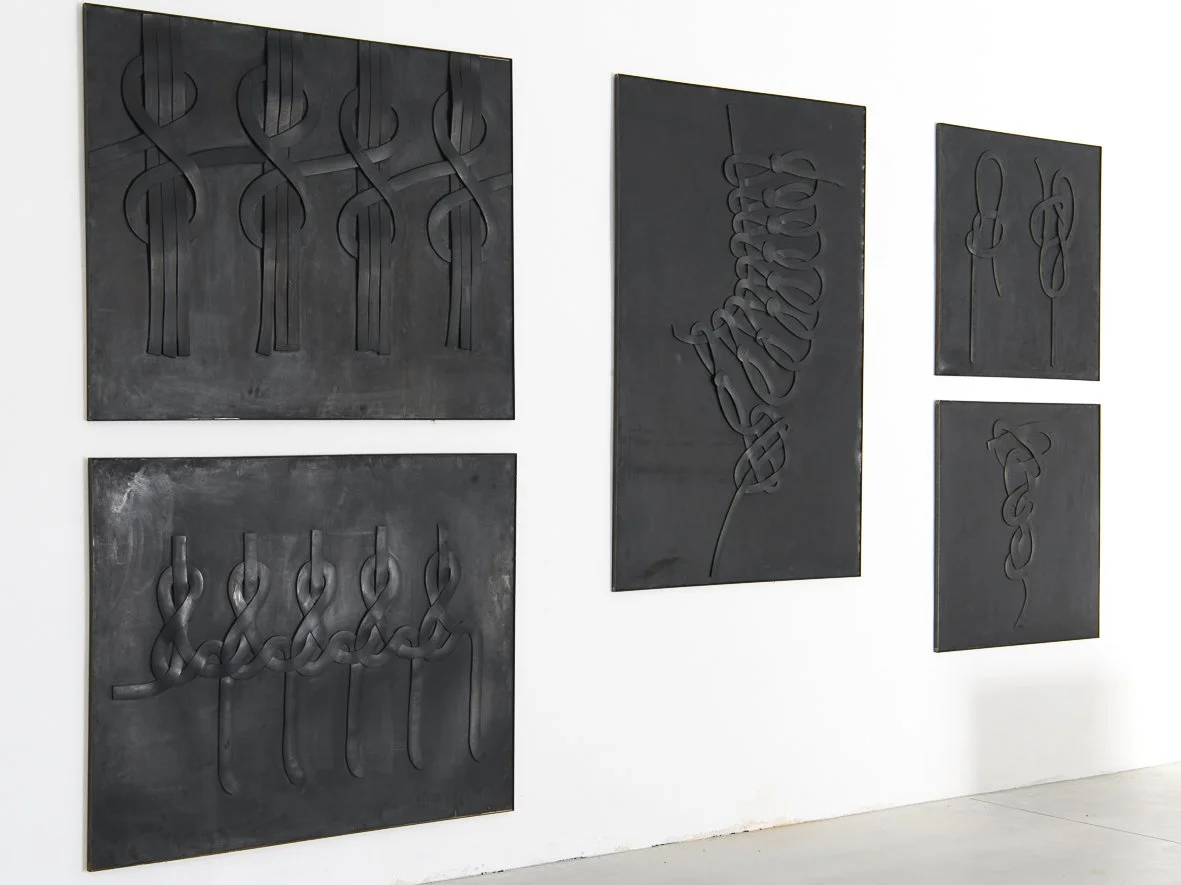
The second theme is tangles, built outwards from visiting the Tangles exhibition at the Łódź Museum of Textiles (26th October 2023 - 28th April 2024). The exhibition itself contains a range of Wolski’s works, including a number of his tangle forms (Seam, 2009), which are rendered in relief and three-dimensional forms across his studios at Dańków and in the exhibition. The tangle could be considered a corollary of the knitted chains in that they also include a looping over and around, but I want to think about them separately here in two ways: the first is the way in which they hover between something that could slip away readily and return the ‘thread’ to a single floating line and becoming a knot that is held fast; the second is their capacity to offer a site for thinking about what it means to be care-full in community. These two come together in the management of the tangle.
Finally I consider gouging, which in Wolski’s practice takes on a sacramental tone allied with a sense of very human desperation. He creates sculptural forms such as Cave Wall I and Cave–Body Imprints (1993) by drawing out the core with his hands. The scraped-out parts are not discarded but retained, memorialising the handfuls of clay as the negative space of those hands and their gouging. The ritual processes alongside the growing pile of evidence of the physical labour act in dialogue.
Across all three themes, Wolski’s work is fecund, it is libidinal, it is bodily and emotional. I am struck by this fecundity that seems to sidestep masculine tropes of phallocentrism and power-based discourses. What I find in this work is a sensibility of care. The links and chains, tangles and gouging hold one another in relational interplay, their inner and outer parts caressing the inner and outer parts of each other. The forms, whether in a gallery setting or in Dańków, set by the lake, link into and out of each other. They create multiple reflections and shadows that come into relational interplay with one another. They fuse nature with human endeavour. In this human-non-human dialogues are enabled; clay, wire, paint and marble appear to have only just solidified from their fluid state, creating a sense of bodily viscosity, a palpability and a contingency that is at once both full and empty, contained and excessive. To collect emptiness is to reside within this capaciousness which cannot be held in stasis.
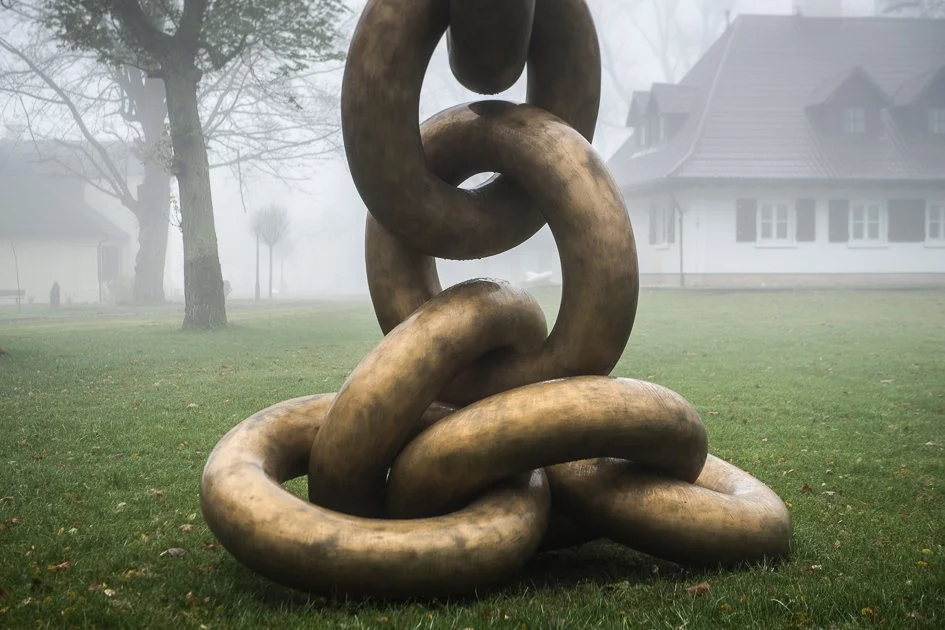
Chains – around the estate chains, sometimes two links, sometimes multiples, even thousands, appear and reappear into view, each link resting into the space created by the other(s) (Borderline 2012, Red Desert 2012). Like the warp and weft within cloth, here the links function in relationship with one another. In this sense they speak of the human spirit, of Wolski’s apparent yearning to collect or hold emptiness. As I make my way around and through the three-storey grain barn that houses his early works, this intentionality is threaded through the various rooms. Each room would have originally been for a different grain harvest, a space for drying the grain ahead of storage. The pipes through which the grain travelled are still present within the spaces and there are openings between spaces to allow air and moisture to move freely. These openings now become communication channels, where themes and re-visiting of themes occurs across this early part of Wolski’s oeuvre. I follow the chain, the thousands of links that Wolski determined to make for each sculptural work, each formed, fired and joined.
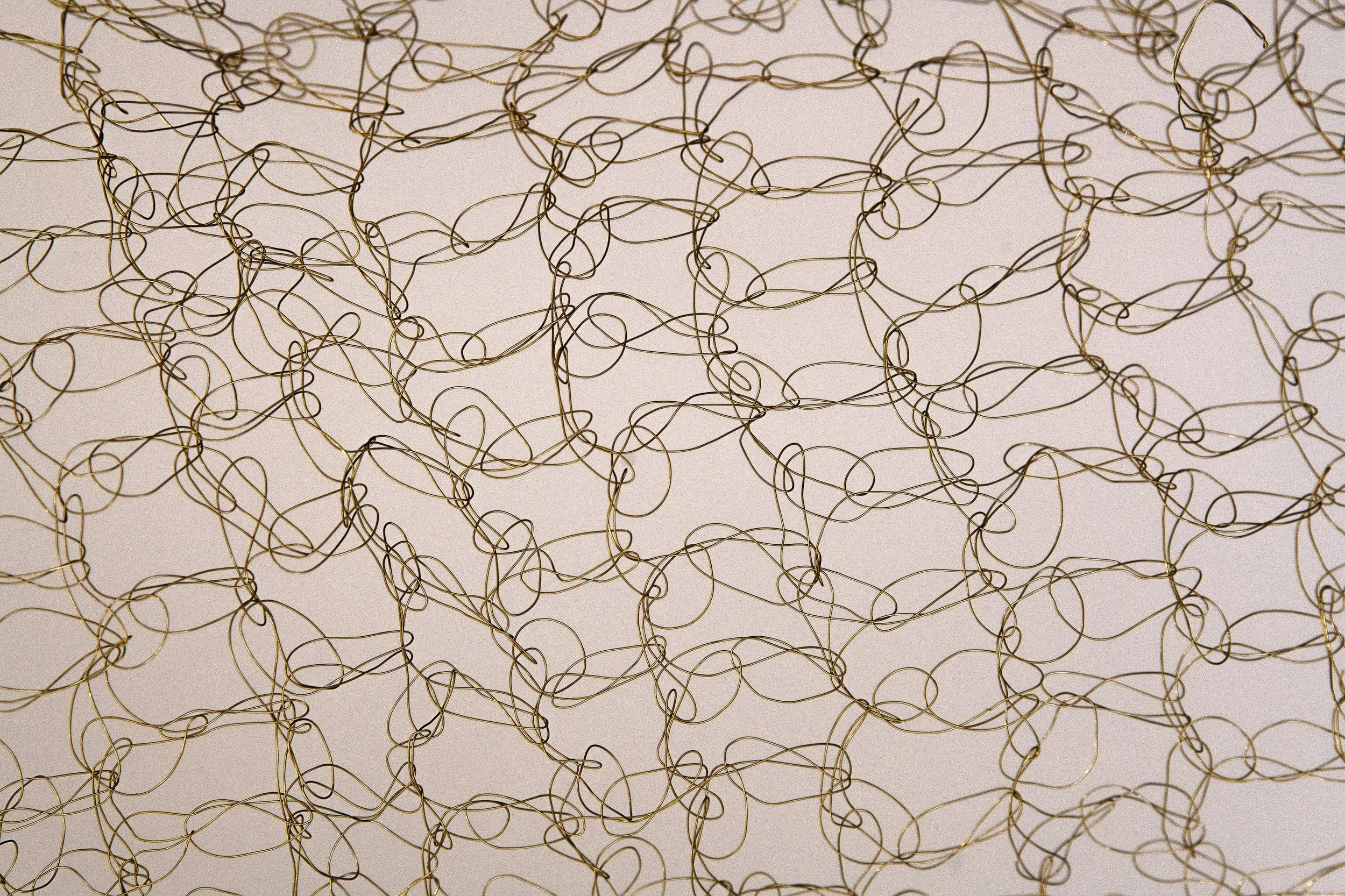
Much has been written about Wolski’s chains (Xawery Wolski, 2020) which has become a language relating to chains of people and intergenerational transmission through genetic chains. In both senses, Wolski seeks to emphasise human strength when considered together. Wolski speaks of his family estate and the way in which his father, Tadeusz Wolski, a professor of agronomy and plant breeding, developed many strands of rye, wheat, and triticale on the estate which were later propagated worldwide. Much like this, the chains speak of reproduction, small changes leading to systemic shifts. Here, however, I want to turn to a different form of chain, that formed by twisting and looping wire (Vellum, Air Circle). In the gallery in Lodz and in the barns in Dańków a series of looped works expand and contract as their formation allows. The looping in question, a form of finger knitting, builds row upon row, sometimes along the length and back, sometimes in the round. In this series (Air Circle IV, Cumulus, Progression, Mrok, Vellum), a body of work known as Pneuma - Air & Spirit, the form is mostly circular. As the first loop is formed, another secures it, then another and another and soon a short chain appears, which is either looped around to create a small circle of about 4 or 5 such loops or extended to create a longer length. This is the base upon which subsequent rows rest, each loop dependent on the previous and the next for its own existence. If one chain breaks, the whole becomes compromised. Knitting of this kind is an important point of departure when considering Wolski’s chains and loops; they speak of inter-dependence and, what Karen Barad calls, intra-actions which extends and gives agency to the relationships that exist within the knitted forms. Intra-actions place emphasis on agency as a dynamic force between two or more elements that depend on one another to exist (Barad, 2007, p. 141). This acknowledges the entangled nature of existence and dependence, what it might mean to be in community with others (including non-human others).
If this sounds somewhat metaphysical when discussing knitting and knitted wire, that is intentional. These forms, like the more solid and heavily present chains act as a form of signature in Wolski’s work, offer space for thinking about being in community, breaking away from Cartesian dualities and enabling a much more fluid, slippery and, potentially, fecund space.
If each loop is in intra-action with the other loops: the previous loop, the subsequent loop, the rows of loops on which it is built and the rows of loops it provides a foothold for, then the knitted form becomes a material form at the same time as a body inscribed with sociocultural potential. It becomes a body in motion. The evening I visited Wolski on his estate at Dańków, followed the most perfect late spring day and as evening fell we were in one of the barns with Persuasion (2010) and in that moment, it became that body in motion. The suspended bulbs hovered in the light breeze, the evening light cast golden tones onto the wire, each loop offering its own shadows at the same time as reflecting light back. The rounded wire sends light rays in many different directions. Each bulb individually is its own universe of light-making. As a massed collection, the loops and light and shadows become a dance, bodies moving against, and with, one another. Like communities of bodies, intra-action does not offer solidity or stability, but dwells, even revels in the pulsating contingency of relational existence, offering a radical reworking of traditional ideas around causality.
Thus the loops are contingent upon the form which in turn is contingent upon the loops, which are formed around one loop of wire wound around the fingers. Wolski’s process is not new; the looped form is found in ancient cultures across the globe. It was a chosen method where flexible and expandable forms are required. It requires no complex technologies or tools and it is highly transportable both in production and when formed into baskets, coverings, panels etc. Research into the Papua New Guinean bilum, a looped form that becomes basket, cradle, amulet holder, ceremonial cape - the sacred and profane functioning through this one form.
I am reminded of the bilum when I spend time with Wolski’s looped forms; the way in which the women of Papua New Guinea carry the bags suspended from their heads down their backs, creating a form that mirrors a woman’s belly in pregnancy, with all the fecund meaning and sociocultural value that form takes. Wolski, too, draws on that expansive meaning-making with his floating bulbous forms, his panels, dresses and circles that undulate and shimmer across the spaces they inhabit (Air Circle, Cumulus, Mrok). Chains and loops intermingle, loops hold fast onto loops, intra-active and potent energy seeping out from the spaces made with these forms.
Gayatri Spivak writes of language and meaning-making using the textile-based concept of the fray, noting that when language starts to break down, when it is insufficient and inadequate, its structures become revealed. She calls this ‘spacy emptiness’, a space where meaning can ‘hop in’ (Spivak, 1993, p. 202). She uses translation as her thinking space and is interested in the role of idiom and its capacity to take the translator to that edge, where language starts to fray. This is also a space of great intimacy, orchestrated by the translator, between the two languages, and it is into this that Spivak speaks of being ‘beside language, around language’ (1993, p. 201). I am interested here in this spacy emptiness and the seepage of energy within Wolski’s knitted works (Progression), in the way that the intra-activity between loops here defies logic and logical structures. Spivak talks further about the role of surrender in translation as being ‘more erotic than ethical’ (1993, p. 205), by which she means that the translator must ‘surrender herself’ and in that surrender she creates further emptiness and thus space for further meaning to hop in. In Wolski’s knitted forms emptiness is formed that is contingent and temporary, built upon intra-actions and entirely dependent upon the number and size of the rows formed, dependent upon the way in which the knitted form is suspended, or mounted, or draped. The looped forms are utterly dependent upon this seemingly endless system of intra-actions - relational to their core.
Tangles – I see one tangle in the house – just in the passageway that Wolski passes through many times each day. It is blood red on a crimson background; the work is part relief, part sculpture, part painting – it defies definition. The central form reminds me of the line from Shakespeare’s Twelfth Night (Shakespeare, 1903) in which Viola utters the lines
‘O time, thou must untangle this, not I.
It is too hard a knot for me t'untie’.
She reflects upon the complexity and the implications of the subterfuge she has been forced to create and that the only way out of it is through time. In the same way, a tangle of threads is best released not through pulling or tugging of the threads involved, but by patient and gentle releasing of the elements. Wolski’s tangle relief hangs at the precipice between becoming a tightly formed knot or released threads. The viewer can clearly see the two ends, can see how the threads wrap under and over one another and is apparently offered the decision to pull or to release. The form is gloss blood red and hangs off the ground canvas like blood or organs; there is something deeply feminine, uterine or menstrual. I am intrigued at this form and its clotted nature, particularly fraught at the lower end. This is distinctly not intestinal nor does it speak into a religious, blood narrative, nor does it set forth an heroic/martyr affect. I do not want to offer simplistic or essentialising readings of this work, but it begs me to understand, it draws me into its tangled form, its situatedness between relief and painting, its rejection of tropes.
To speak of tangles in terms of thread, sculpture and painting as conjoined, entangled, practices sets up a rhetorical way of thinking that in itself echoes or leads, the tangles. The red tangle I first encountered in Dańków becomes a juncture, possibly a wound, but certainly a hiatus. I see many tangles as Wolski guides me around the estate and in the exhibition in Łódź, and they all appear to emerge from this one that sits at the heart of this domestic setting.
To entangle means ‘to involve in intricate paths or among obstacles’ or ‘in surroundings that impede movement or from extrication is difficult’ (Murray, 1972). I am drawn into the works through this notion of impediment in the face of the form’s own complexity. If the ends of the tangle were able to be pulled, would it simply unravel into a length of thread or would a knot, a tightly enmeshed tangle appear?
However, the potential for being entangled also offers scope for thinking into Wolski’s work as a form of expression beyond the self, beyond ego and towards solidarity and creative dialogue with others or another. In textile practices, such as weaving, knitting, felting and crochet, processes of entangling are the very mechanisms for creating: twisting, interlacing, mixing and knotting become cloths of many types and for many purposes. Most industrialised countries have textile production at the heart of their technological and commercial development.
Karen Barad suggests that the ‘primary ontological units are not ‘things’ but phenomena - dynamic topological reconfigurings/entanglements/relationalities/(re)articulations.’ (2003, p. 818) Thought of in this way, things only come to matter if in relation to one another. Similarly cloth only exists if warp and weft or loop after loop come into relationship. To think in terms of entanglements and entangling is to think through the messiness, the knottiness, the matterliness that allows the freedom for the parts to cohabit.
Reckoning with the ways in which communities are entangled in the current context also requires understanding or acknowledging how each of us is simultaneously the beneficiary of our heritage and also the victim of it. We are entangled within this. We cannot speak of culture or community without speaking from it. We, like the tangled thread that form cloth, are woven into these very cultural structures, implicated and complicated at the same time. Wolski’s tangles thus create a transformational space: they offer scope to speak of how communities are produced, repair and reimagine themselves across time and space. This is to take the concept of transformation not as tectonic shifts, grand and spectacular, but rather as incremental, daily, patient, sometimes imperceptible and, at times, frustrating and apparently making things worse. Reckoning requires forms of care - towards people, materials, places and environments, but above all care of community. The handmade and handmaking perhaps take on care-full language more readily, but this also comes at a price. It is again, an entangled situation.
Care can be considered in terms of precision in making, as an expression towards another or others and as a way of human and more than human communities. Thus Wolski’s tangles offers us a way to think about this connectivity. It allows us space to consider what networks of people, communities, can be created and how this community and connectivity might be transmitted to others. As the loops are formed and become tangles, so new potentialities can be added. In this sense, the looping becomes not only a material practice producing material forms, but also an imaginative, generative practice. Wolski’s tangles become an expansive, matrixial forcefield, drawing others into its reach and reaching out to others.
Further, as the tangled forms, both those in relief and those cast in three-dimensions, catch and reflect light, they also cast shadows, creating new reaches of community and connectivity. These are affective spaces and sites for mutual reciprocity. To frame this affectivity in terms of care is to consider not only the precision of making, but to add the making of the shadows and reflections and to materialise what an affective community can produce; they duplicate, replicate and complicate each other within and beyond the community.
This reckoning and connectivity also involves holding the community to account: it cannot exist in isolation. The tangles are only tangles if the loops support one another - there is always the risk of untangling and separation. If one loop breaks, the whole is compromised, including its reflections and shadows; everything is amplified within the tangled community.
As a language for talking through care, Wolski’s tangled looped forms present us with powerful metaphors and structural forms that can aid our understanding of what human and more than human communities can be. They offer scope for speculative thinking. If we ask these works what it means and involves for a community to reach out with care, we must look not only to the reflections and shadows in the moment, but to think about how those affective elements of the community change according to the prevailing context. By this I mean they change according to the physical space in which they are viewed: Wolski’s blood red tangle in a domestic vestibule suggests a community of intimacy, possibly erotically charged, certainly speaking into the bodily notions of being in intimate relation with others. Beyond the sexual, such relationships are libidinal, pregnant with potentiality. Wolski’s tangles allow scope for thinking about what happens in these relationships and their capacity for change. When natural light falls on the forms, shadows and reflections come as companions, co-creators of community. As the light shifts and changes across the day (and night) and the seasons, not only in terms of the position of the light source, but also in terms of its texture and intensity, so we are offered a vision of how communities of care can, and must, shift and change. The shadows cast on a bright sunny day are intense, hazy and rich with detail, but on a cool, overcast winter’s day, they might at first appear to be absent; closer inspection reveals subtle, blurred shadows, more a sense of the whole than the detail, with less defined, or more mutable edges. Here community’s boundaries are perhaps at their most porous or most ill-defined. Is one better than the other; is one more successful than the other. Wolski’s tangles become a space for reverie, for thinking about entanglement as a forcefield for community-making. They are networks and networking.
Gouges – as I tour the grain barn with Wolski he talks of studying in Carrara, Italy, of having the marble mountains and quarries as a primary frame of reference. He speaks of studying in France, both in Paris and in the south of the country, in the 1980s where he found himself trying to find a way to articulate his context and frames of reference which lay outside of the prevailing mood in Western Europe of that time. His narrative tumbles across timelines, the thread is more about how he found a way through the materiality of clay not marble; its softness allowed him to gouge and to mould, to manipulate and embed rather than chip away at the solid block. He shows me some marble reliefs into which he has carved footprints that look like those made in soft sand; these are delicately formed and I can understand in part why he has found clay to be such an important medium (Grave Stone, 1987).
We speak of Anna Maria Maiolino who makes a ritual of producing repeated elemental forms in unfired clay, setting them out on tables that become part altar part dinner table, she talks of the hand as ‘the first form’, relating to her work of the late 1980s, coincidental with the era when Wolski was working in a similar way. She too was working within a restrictive regime, in the context of a dictatorship in Brazil. Briony Fer writes that, for Maiolino, ‘the body is a cipher of meaning… part of her anatomy of part-objects and bodily organs that is the modern.’ Fer also references that her body acts as one of many moulds that are her preoccupation (Fer, 2010). Where Maiolino kneads and rolls, Wolski gouges, but these are both mechanical actions that somehow seem exempt from industrial models and modernity. The organic materials become repetitively and serially presented as grids, systems and piles, but these systems highlight the individuality of each form and the differences between them.
Wolski’s mass accumulations and overscaled forms crowd out the floor, rooms and spaces within which they are placed, bringing a sense of impending disorder. The forms and tangles speak of instability. The overcrowded sections of rooms give way to capaciousness in others. There is relief before being overwhelmed once more; crosses moving along the floor and up the wall form an altar of sorts.
In his book Hyperobjects (2013) Timothy Morton turns to the concept of viscosity as a force that sticks to oneself. He speaks of aesthetic experience as something that pursues his innards, searching out the resonant frequencies of his stomach, intestines and face. Drawing on Jean Paul Sartre, his language turns to that slipperiness of the viscous, its ‘sly solidarity’ between things or, as Sartre puts it ‘the slimy is myself’ (1943, p. 777). What is foregrounded here is the sense of the viscous substance that falls back into itself, sticky returning to sticky and slowly dissolves once more (Morton, 2013, p. 30), I turn to these thoughts of viscosity and stickiness in relation to Wolski’s gouged out forms as it offers a phenomenological rather than philosophical space from what we, in our humanly embodied form, become embedded in the earthly reality of those forms. Our bodies can collapse into the clay forms, in a chiasmic act of rhetoric: it offers a sense of completeness through its reversal of structure. As the hands reach in to gouge, so the gouging reaches out towards the hands.
While for some the studio might become a space for solitude and escape from pasts and presents, for Wolski it appears that he openly encourages a range of voices and art historical collisions in to create a heady mix of thoughts and reflections, wrought through his material choices.
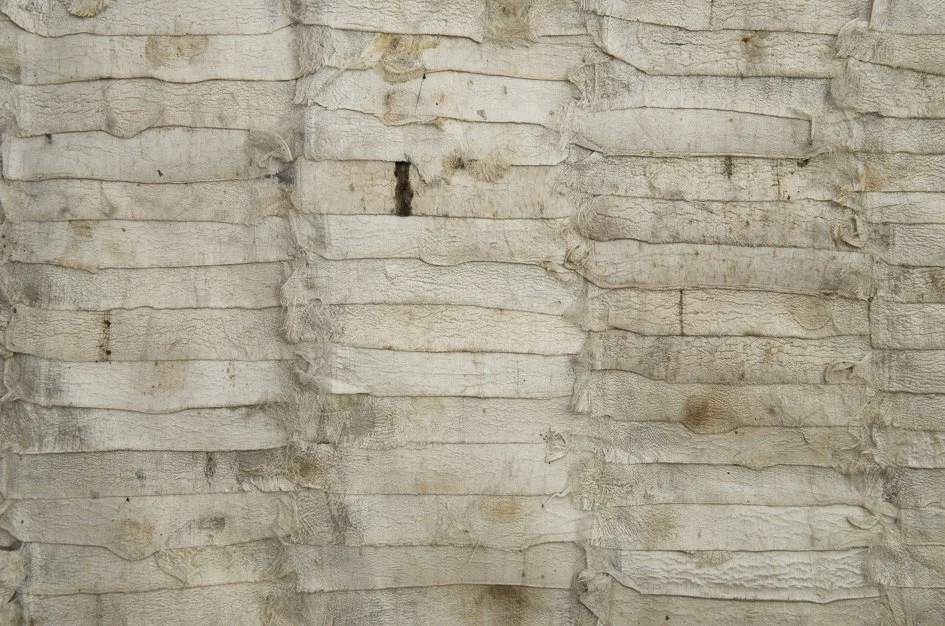
In one barn Wolski shifts the focus of the gouging chiasma towards silkworm cocoon shells, the parts left over after the silk has been harvested. We discuss the careful process of producing natural silk, of feeding silkworms with quantities of mulberry leaves on which they gorge themselves before spinning their cocoon ready for that miraculous process of metamorphosis into silk moths. A short-lived life, the moth’s purpose is to lay eggs for the next generation of worms and so the cycle of life repeats. To extract silk the farmer must remove the cocoons early in the process and boil them to both kill off the transforming worm and to release the silk threads from their gummy substrate. The farmer must take care to leave enough cocoons to ensure a good number of moths hatch and lay their eggs.
Wolski works with the waste cocoon shells, laying them flat and reactivating the remaining gummy substance to join them into large striated canvases such as Silk Landscape III (2013), or hanks of threadlike forms as in Silk Road (2010). The lustre across the surface of these works is picked up by the evening light in the barn and the gallery lights in Łódź’s Textile Museum as part of Wolski’s ‘Tangles’ exhibition. The colours shift from bright white to the earthy browns of the gouged clay works Cave Wall I and Cave – Body Imprints (1993). As Wolski dragged with his hands, so the worm forms with its body, both working through the stickiness and both, eventually, requiring a form of digging out, gouging.
Silk thread and cloth is known for its lustre and drape. It is soft and skin-like, temperature regulating and holding anti-bacterial properties. It is also a viscous substance, hovering between solid and liquid. If we return to Sartre, he says of viscosity that it is ‘neither material nor psychic’ (1943, p. 627) but a phenomenon that transcends the opposition of mind and body, that privileges clinging-ness. Mary Douglas finds in the viscous a state ‘in a process of change’ (1966, p. 38) and, like the silkworm, a space for reconsidering a subjectivity in which the solid and visible can be replaced by the viscous and the felt, collapsing boundaries and bodily edges.
In Wolski’s works there exists a form of ambivalence within the fecundity, that focuses upon this stickiness. For Sartre, writing of depression in Nausea (1938), this is a dangerous space in which the body, the self, is threatening to dissolve into itself and into its physical and psychic world. In Silk Landscape III (2010) and Oilcloth with prints (2022/2023), as with much of his oeuvre, we can see a play with this self-dissolving, not as self-indulgent or autobiographical narrative (although this is undoubtedly present), but rather as a means by which to explore what freedom can and might mean. This brings a sense of yearning for freedom to the work. The gouged-out forms and the pressed cocoons are framed by preoccupations with seeds, chains, tangles, oversized dresses and neckpieces, beads and pierced works (known as tattoos and in themselves offer another form of gouging out). I am intrigued by the internal/external interplay in relation to the idea of gouging in Wolski’s works. Hannah Arendt, in On Violence (Arendt, 1969) speaks of violence as being ‘by nature instrumental’, requiring justification by the end it pursues (1969, p. 44). Gouging is both a desperate and violent set of actions. Where Wolski claws out clay, excavating his forms, the silkworks whose residual casts he uses, first spin that cocoon, then chew their way out for their short-lived life as a moth. In both cases we can see systems of power played out with violent actions embedded within. ‘Power and violence’, Arendt reminds us ‘are distinct phenomena’, but they usually appear together (1969, p. 45). ‘Violence can always destroy power; out of the barrel of the gun grows the most effective command, resulting in the most instant and perfect obedience. What never can grow out of it is power’ (1969, p. 46).
Taken in the context of these works (Silk Road, Silk Landscape) Wolski’s gouging, together with his gouging by proxy through the silkworm, takes on this dialogue between power and violence: the artist must give over his power and ego in relation to the clay in order to find the language of the gouge. He uses this language precisely to diminish power structures and so offer the viewer a vision beyond power and violence, wrought through a desperate, violent set of actions. As we meditate upon the clawed-out forms, the splayed silk cocoons, we become caught up in this interplay and directed towards the potency of collective action. They offer a space to both realise Proudhon’s remark that ‘the fecundity of the unexpected far exceeds the statesman’s prudence’ (quoted in Arendt, 1969, p. 7) and for realising and materialising such actions as considered, political and agential forms of expression.
Returning to the concept of collecting or holding emptiness, I want to signal here that Wolski’s gouging out, creating and collecting emptiness (the clawed out pieces are retained, forming an evidence trail of the actions and intra-actions of the gouging), also becomes a way of thinking about being in community, it is an invitation to come into sticky relationship with the materials and materialisation of experience and the artist. The stickiness allows time, holds space, for close encounter or, as Arendt would frame it, space ‘for the mind to go visiting’ (1982, p. 42) and this visiting, as I would argue visiting does necessarily, entails not standing in assomeone else, but standing beside them, to listening and hearing to their perspective in mixture with one’s own. The resultant elisions, revisions and new understandings drawn from this experience allow each’s knowledge and thus imagination to become broader, something Arendt, following Kant, refers to as ‘enlarged mentality’ (1982, p. 42).
As we look at the marks on the clay, the gouged out handfuls of clay, and the connections to Maiolino’s ‘first form’, Wolski’s hospitality, his open-house invitation, precedes him. This suggests an imagination that moves beyond an autobiography and speaks to a transnational denizen. The denizen, Marsha Meskimmon asserts, ‘makes herself at home everywhere’ (2017, p. 25), but further becomes a way of ‘imagining and materialising ecologies of belonging’ that belong to a post migratory world (2017, p. 25). Most importantly, Meskimmon speaks of ways in which art and art practices have the capacity to materialise space for thinking about worldmaking that is plural, inclusive and a reflective-progressive event within the world and she invokes us to adopt denizen-like mindsets and imaginations to enable this.
Holding Emptiness – let us return to the question of what it means to hold or collect emptiness. In the gaps and spaces in Wolski’s artworks we find repeated themes and form that he troubles over extended periods. Visiting his studios and the Tangles exhibition in Łódź I am struck by this seeming excess of repetition. And yet, this also offers a space for, and of, meditation. As the loops form upon loops, providing space for further loops, repetition draws together past, present and future forms into a contingent space of intra-action. This takes us beyond simple dependency and into agential relational play. Where knitting offers a realisation of forms that can expand and contract, producing space without excluding, tangles hint at uncertainty from another perspective, asking of themselves and viewers, what will happen if I pull the tantalising tails or push my hand into the loops. Both speak of emptiness being held but not contained. This is Spivak’s spacy emptiness, this is where meaning can hop in. Whose meaning is a pertinent question. I would suggest that what Spivak is pointing to is precisely the point, it is through and with such emptiness being temporarily held that multiple meanings can emerge. Where Arendt speaks of visiting, she again speaks into a temporary temporality; this is not about solidity.
Gouging initially appears to act as a contrapuntal moment in relation to knitting and tangles, but I want to suggest here that in its challenge to the concept of the boundary, holding emptiness rejects inclusive-exclusive thinking and processes in favour of thinking and making through networks, connectivity, intra-activity and inter-relationality. This is, necessarily, an imaginative and speculative set of spaces and sites of activity.
Through knitting chains, tangling threads and gouging forms, Wolski’s artwork offers scope for extending our frames of reference and thus what it might mean to be in community. The speculative and contingent networks and forms can become sites for refocusing and imagination. In Wolski’s artworks we find an invitation to become Meskimmon’s denizen, where we can begin the process of ‘imagining and materialising ecologies of belonging’ (2017, p. 25). Wolski helps us, through his materialisation of emptiness, to make space for thinking about worldmaking that is plural, inclusive and a reflective-progressive event within the world. He asks us to hold the space gently, but boldly and to reject fixed boundaries and meanings. This is an invitation to adopt denizen-like mindsets and imaginations that are expansive, generous and capable of going visiting. He invites us to join him in collecting and holding emptiness.
Bibliography
Arendt, H. (1969) On Violence. 2023rd edn. Available at: https://www.penguin.co.uk/books/455313/on-violence-by-arendt-hannah/9780241631645 (Accessed: 1 September 2024).
Arendt, H. (1982) Lectures on Kant’s Political Philosophy. New edition. Edited by R. Beiner. Chicago: University of Chicago Press.
Barad, K. (2003) ‘Posthumanist Performativity: Toward an Understanding of How Matter Comes to Matter’, Signs: Journal of Women in Culture and Society, 28(3), pp. 801–831.
Barad, K. (2007) Meeting the Universe Halfway. Duke University Press. Available at: https://www.dukeupress.edu/meeting-the-universe-halfway (Accessed: 4 April 2022).
Douglas, M. (1966) Purity and Danger: An Analysis of the Concepts of Pollution and Taboo. 1991st edn. London: Routledge.
Fer, B. (2010) File Note 51: Anna Maria Maiolino, Camden Art Centre. Available at: https://camdenartcentre.org/file-notes/file-note-51-anna-maria-maiolino (Accessed: 1 September 2024).
Meskimmon, M. (2017) ‘From the cosmos to the polis: on denizens, art and postmigration worldmaking’, Journal of Aesthetics & Culture, 9(2), pp. 25–35. Available at: https://doi.org/10.1080/20004214.2017.1343082.
Morton, T. (2013) Hyperobjects: philosophy and ecology after the end of the world. Minneapolis: University of Minnesota Press (Posthumanities, 27).
Murray, J.A.H. (1972) Oxford English dictionary. Oxford: Clarendon Press.
Sartre, J.-P. (1938) Nausea. Translated by R. Baldick. London: Penguin.
Sartre, J.-P. (1943) Being and Nothingness: An Essay on Phenomenological Ontology. 2003rd edn. London: Routledge.
Shakespeare, W. (1903) Shakespeare’s Comedy of Twelfth Night. London: J. M. Dent & Co.
Spivak, G.C. (1993) Outside in the Teaching Machine. London: Routledge.
Xawery Wolski (2020). Milano: Skira Editore.