Eva Meyer-Hermann
Back From Nature
Question 1: Which is heavier: a kilo of feathers or a kilo of lead? We were often asked that at primary school. And everyone would shout “Lead!” Haha, got you! And question 2: What are shadows? Do they extinguish an image by darkening it? And what if they’re cast into the world by an object of some kind?
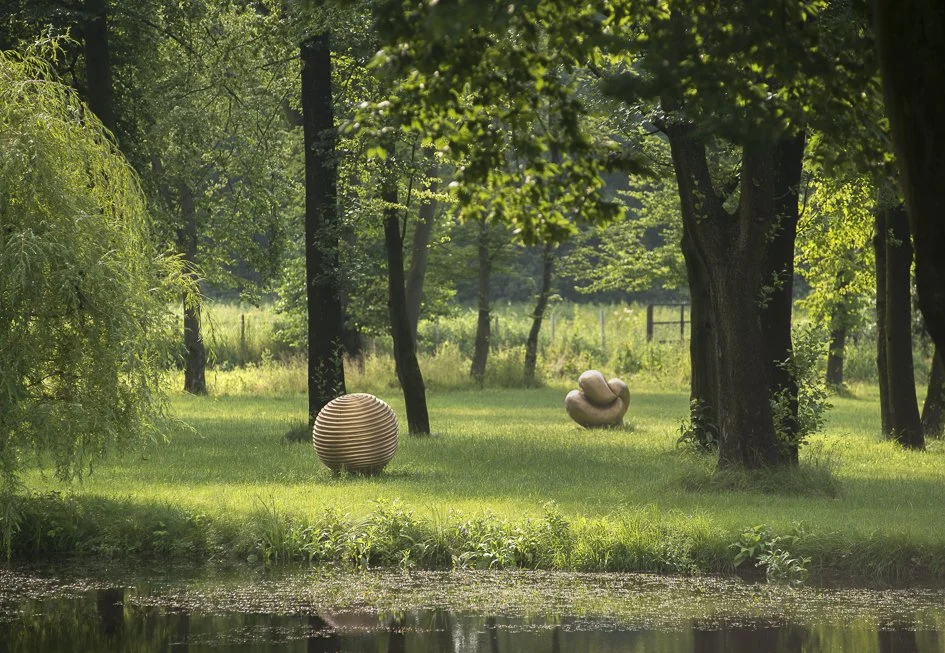
It is hard to estimate the size of the shimmering sphere in the distance in a park. It rests there on the grass as if it had only temporarily come to a halt. It’s impossible to say with any certainty if it just rolled there under the trees or if it is an unidentified flying object that landed there at some point, or an artifact intentionally introduced into that reality. Whatever the case, there it is, proudly gleaming in the sun, reflecting the light striking its surface. Only the areas in shadow diminish its air of self-confidence. Light plays on its outline, emphasizing the plasticity of the surface that has been created by a coil spiraling around it, forming parallel, non-horizontal “ribs” that accentuate its slightly out-of-kilter axis. Small irregularities reveal that this object was made by hand. Although we know we are gazing at a bronze sphere, it looks like a clay vessel that has been made on a potter’s wheel using a spiral coil technique. And our slow approach to the object does not make it any the less mysterious — we can’t take it in all at once and thus gain a better understanding of it. On the contrary, it grows bigger and bigger until it is starting to loom over us, filling our field of vision.
Positioning, placing, arranging — materials, gravity, and balance are universal parameters for sculpture. The sphere in the park combines and even goes beyond all of these. It appears to be leaning to one side because its axis is not vertical, only it cannot start to roll away unless the ground beneath it actually tilts, causing the sphere to succumb to the Earth’s gravitational pull. Perhaps the heavy burden of the celestial sphere slipped from the giant Atlas’s shoulders, landed on the ground, and rolled under the trees where it came to a standstill. Yet there is no reference to the mythological figure of the Titan anywhere here. If anything thoughts of a small, compact sculpture by Constantin Brâncuși come to mind. His fine Sleeping Muse, cast in bronze in 1910, is almost abstract. Just a few stylized details indicate that this ellipsoid represents a female head, precariously resting on its side. The indeterminate positioning and the calm that exudes from this poised balance transmit a meditative stillness. In its interiority and hermeticism the bronze sculpture resembles the object in the park. Theoretically there is only a single point of contact between the material and the ground beneath it. Or is it vice versa, that only one point on the Earth makes contact with the work? Who is carrying whom? Who is dependent on whom? These were the questions posed by the Italian artist Piero Manzoni in 1961 when he placed a block of iron on the ground with an upside-down inscription that reads “Socle du monde” (the world’s plinth). This work’s reflected sensuality arises from its conceptual impact, in that it requires viewers to up-end relations in their usual thinking.
It is time for us to pin down what has been said so far: in fact we are in the grounds of a Polish estate in the countryside near Dańków, which is around seventy kilometers from Warsaw. This estate, once home to the Wolski family, was expropriated by the Polish regime after World War Two. Ever since the nineteenth century Wolski’s ancestors have investigated and optimized the genetic makeup of seed crops. Crossing wheat and rye, for instance, produces a robust cereal crop that is still highly valued in Poland and beyond. Tadeusz Wolski, father to Xawery Wolski, was a renowned plant breeder who was employed in Dańków as director of the facility during the Communist regime; meanwhile his family lived in Warsaw. In the late 1990s Tadeusz Wolski was able to buy back large tracts of the family seat, including the properties on the estate. His son Xawery had left his homeland in the mid-1980s due to the aftermath of the imposition of martial law in Poland. It was only after his father’s death in 2005 and some years of rapprochement that he moved back to Poland and turned the estate in Dańków into the headquarters of a foundation for his art. The numerous sculptures now installed in the grounds of the estate include the object we initially approached with some caution: Sphere (2022), bronze, 200 centimeters in diameter. Not far away other related sculptures, such as Vortice (2002–05) await our attention. The spiraling motif that seems to characterize these spherical forms connects all these strange, compact bronze globes as one family, just waiting to be investigated in these extensive grounds.
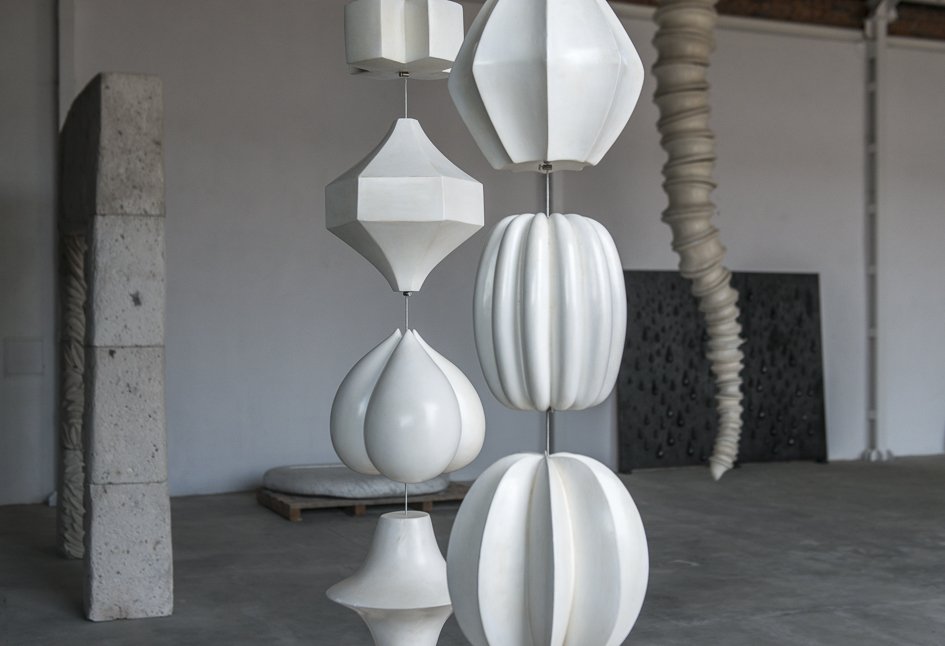
However, we are not in a carefully staged sculpture park with works placed along the paths for our contemplation. The works that catch our eye nearby and in the distance have specifically insisted on their present locations. To this end, in recent years the artist has shifted large quantities of earth, sometimes with heavy-duty equipment, creating mounds, digging out depressions, making dams to fill hollows with water diverted from the stream that runs through the estate, and planting. The result should not be confused with the land art of the 1960s that saw artists extending their Minimalist vocabulary of forms across vast expanses of remote landscapes. The park, or rather, the grounds at Dańków are not home to an open-air art exhibition with sculptures in situ, but rather a cultivated setting with sculptures in vitro, so to speak. The works here don’t pretend to have grown out of the ground like plants: they would never pander to nature in that way. Like a biologist with a test tube, the artist nurtured the works in his imagination and then in his studio spaces, before going on to test them outside. Inside the former farm buildings, the granary and the laboratory, we keep coming across smaller examples of similar formal vocabularies: proliferating cell-like rings (Circles, 1992), vertical suspended strings of star-shaped, curved, or sharp-edged forms (Equations, 2018), which still seem to be in an earlier stage of development.
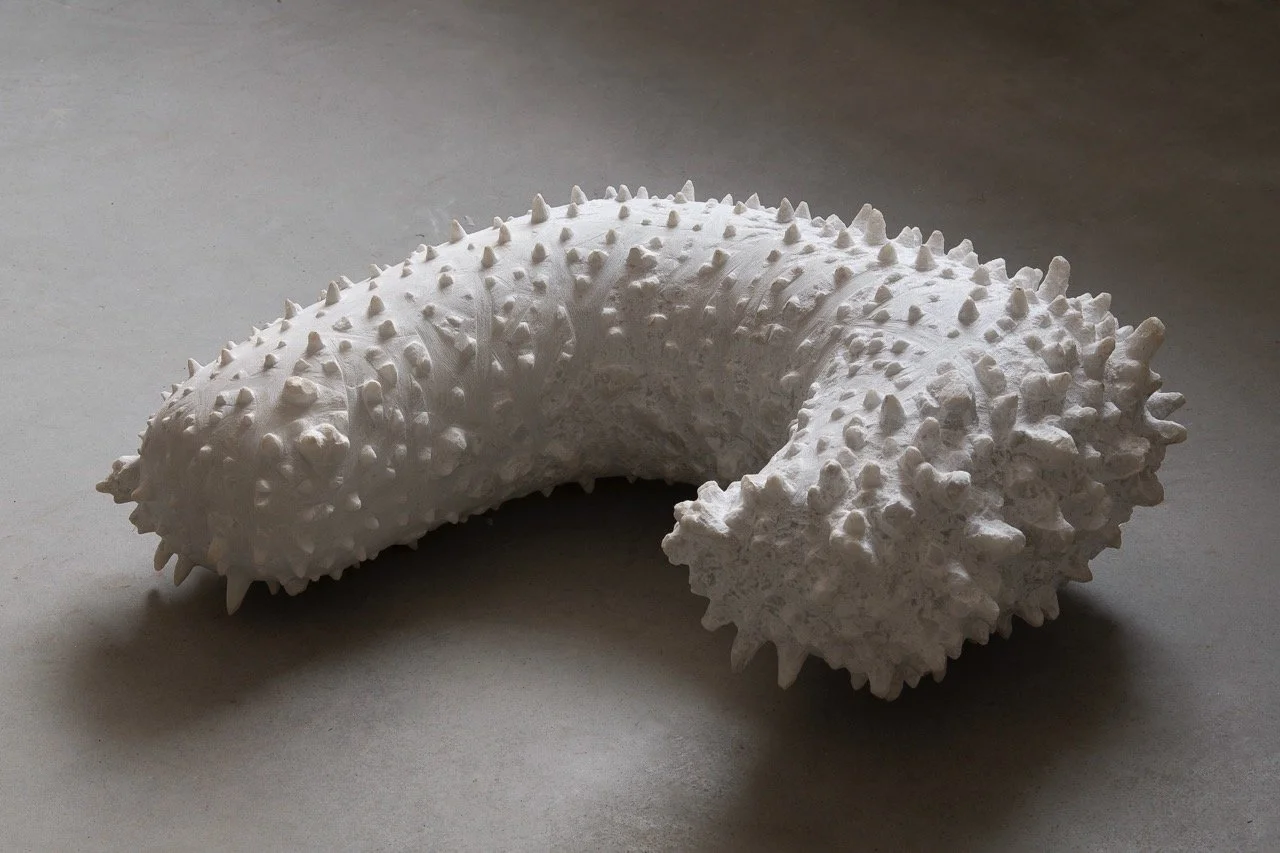
In Father (1986), a white marble floor piece that might easily be overlooked, we are unable to discover any rules relating to a comparably evolutionary reference system. This little sculpture consists of a thick curve of marble forming an incomplete letter “U.” There is something sketch-like about it. It is bent like a fat hook, slightly clumsy, not leading anywhere, not holding anything. It calls to mind stylized body parts that waver between mobile corporeality (arm) and static volumes (torso). However, its most striking feature is the treatment of the surface. It is both threatening and hostile, densely covered with pointed little teeth that sprout out from the strange body part like crystals in varying sizes. It must have been devilishly difficult to carve all these little spikes out of the marble block. This is completely at odds with the idea of a bozzetto, which generally involves using an easily-worked, soft substance to try out an idea that will eventually be executed in a more unyielding material. This seemingly unassuming piece shows just how much effort must have gone into making it. Traces of chiseling and rasping have neither been filed down nor polished — it looks almost like a small, hard chunk of wood that a restless child has been working away at with a whittling knife. As to its meaning, this work is puzzling and inscrutable, but, as a nucleus for later works, it clearly has a role connecting personal and collective history.
This piece was made in Carrara: the first place that Wolski headed for after leaving his native country in 1985. With its world-famous quarries it is one of the most important places for sculpture. As it happens another marble sculpture that Wolski started to work on at around the same time has a similar surface — seemingly the outcome of a rough, almost clumsy way of working: You Were Born Like a Saint with the Consciousness of a Snake (1985–87). Unlike the fragmentary Father, this later work clearly resembles a human figure. Full-length, upright figures are extremely rare in Wolski’s oeuvre, and it is telling that both the early marble figure of a man and the terracotta statue L’uomo celeste (1988) have a minimally worked, fragile, sensitive-looking surface. The standing youth — like a cross between Donatello’s bronze David and the ancient Laocoön Group brings to a close the experiments with figuration that Wolski embarked on in Italy. In a group of works made in 1985 he explored an archaic vocabulary of forms with engravings or low reliefs of hands, feet, triangles, and spirals on tombstone-style slabs—as in Footprint with Rainbow. All the surfaces of these stone slabs are detailed, sanded and polished. The small, comparatively rough-looking sculpture Father found a visual counterpart many years later: In 2010 Wolski started to cover the sculptures in his extensive series on the topic of transformation with countless conical thorns, which, as a form of noli me tangere, mark a seemingly endangered boundary between a sensitive interior and the outside world. In so doing he turned motifs from his earlier sculptural repertoire into a genre of their own.
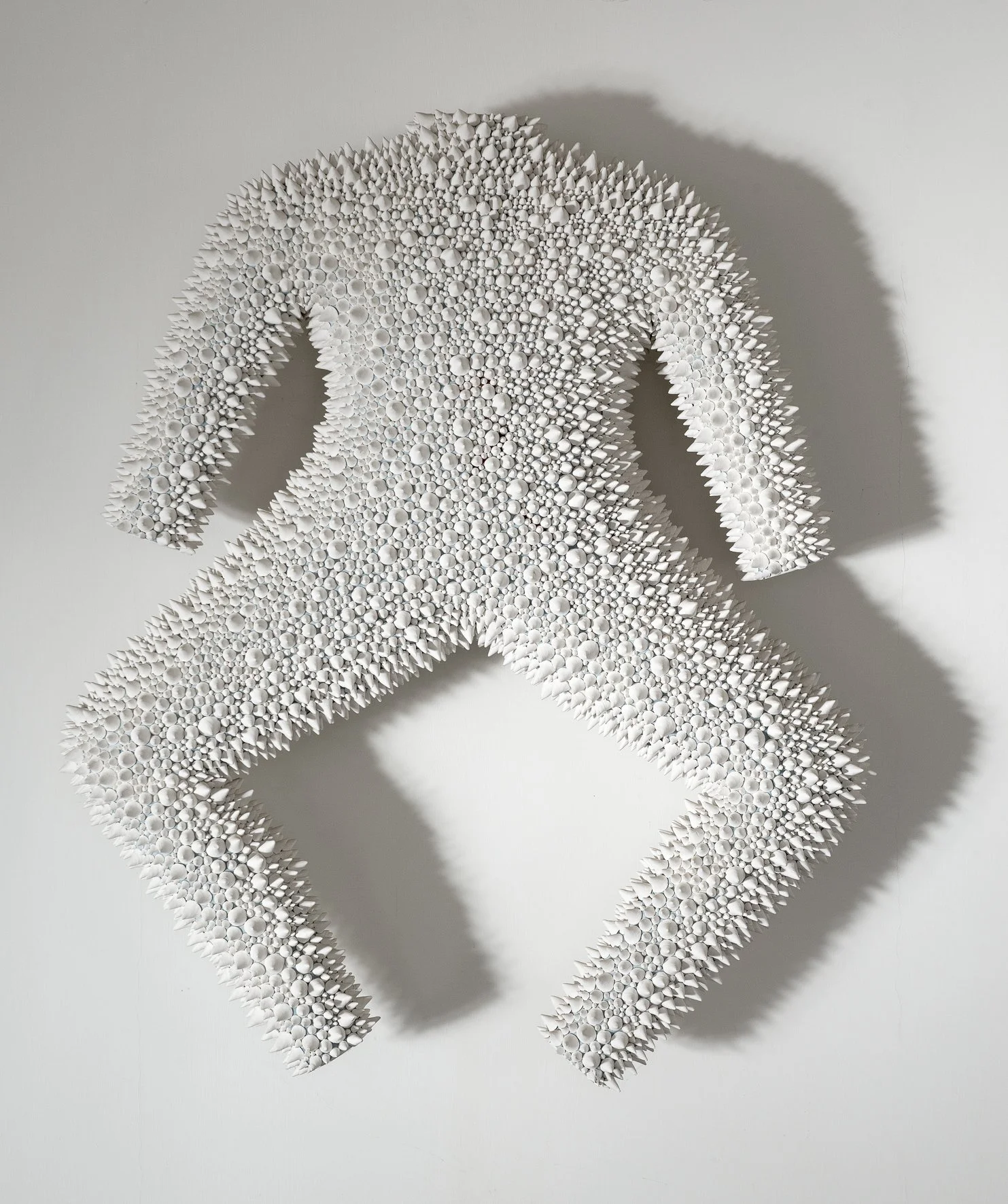
The sharp bristling thorns on the torso in Metamorphosis I (2011), for instance, penetrate the atmosphere like body piercings. They create an aura even as they destroy it. As such they are accomplices to the sculptor’s special praxis when “drawing.” His actions at the drawing board also have something physical about them, because he takes a three-dimensional, invasive approach to his picture carriers. Only in no sense does he mistreat his materials: instead he subtly adds a spatial dimension to the planes in question. Using a sharp object and a staccato technique he extracts sculptural, representational motifs from the paper (Tattoo [multiple works], 1997–2001) or he uses a diamond-tipped engraving pen to incise fine yet distinct lines into hard granite (Lunari, 2010–13). If sculptors do indeed have a particularly keen awareness of the connections between space and time, then that is what we see here. The clearly time-consuming treatment of unusually large picture carriers (Time Drawing IV, 2006–22) or of the three-dimensional pre-formed, flexible terrain for a drawing (Mountain II, 2012) is self-explanatory in the context of Wolski’s ongoing artistic pursuits. These drawings are not impromptus, neither are they the fruit of sudden inspiration nor conceptual sketches for the next sculptural object on the horizon. On the contrary they are meditations that require just as much patience and effort as working with an intransigent block of stone.
By contrast the works that Wolski produced in France, after his time in Carrara, have much more to do with lively spontaneity, serendipity, and variability. In Italy, in 1986, he had already discovered that earthy clay, as an artistic material, could be both meaningful and good to work with. But it was not until he was in the south of France, where he lived from 1988 to 1992, that clay led to a whole ensemble of works. The outcome was a unique genre of terracotta sculptures darkened with iron oxide — the Dark Series — in which, alongside other things, the motif of the chain emerged for the first time. We might picture that moment: while the artist was experimenting with kneaded and rolled strands of clay he suddenly formed a circle from one length of clay, hung another into that first one, and another into the second, and so on. Meticulously, painstakingly, for a long time, on and on, he made one loop after the other — almost like a three-dimensional mantra — and linked them to form one chain after the other. This led to cumulative works, chains in heaps or as planes, as in Dark Chains (1990), or laid out as individual elements whose configurations constantly change, depending on the exhibition situation. The versatile principle of creating sequences and variations of identical modules is part of the legacy of Minimalism, which Wolski has often deployed over the years without ever allowing it to become a substantively dominant theme.
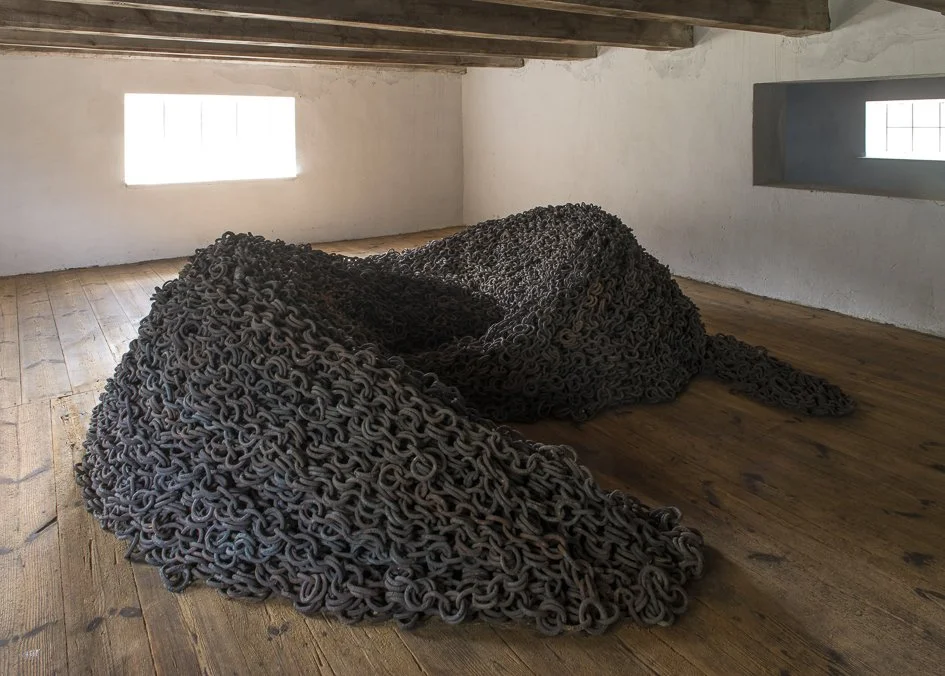
How cold was it when you first saw L’image de l’image (1988)? I rubbed my numb hands together. Relentless cold had spread through my body having first slowly penetrated my snow-soaked boots and freezing feet. We had walked across the mist-chilled, snow-covered expanses from the manor house to the old granary, where the floorboards creaked with every step we took. But the temperature did not impinge on what we saw there: a strange sculpture, almost like a creature cowering on the floor. Or rather: two forms curving toward each other, made from dark, heaped up chains. Their interiority unleashed a tender wave of warm empathy for what looked like two stranded seals on their bellies, curled into each other like a matching pair. Or like two identical migrating dunes, whose ridges form two interlocking, mirror-image C-curves as if in a scarcely credible landscape. Clearly no wind could have come from two directions at once to produce this strange formation. Each curve is supported by paddle-like extensions that serve to somehow bring the elegantly mobile material to a halt. The question of their weight immediately crops up. How heavy are these chains? How heavy is their image? Are these images of chains or endlessly mirroring images of ideas? It was impossible to decide which was the original picture. An image of an image of an image, tautologically turning back in on itself, with no opening, no explanation.
So, neither animals nor a landscape, just a dry ensemble of heavy, piled up chains? Was that really sturdy, secure iron lying there? Reluctantly our perceptive faculties lost trust in that first impression. From closer to, the rough surfaces of these dark components revealed the material they were actually made of: fired clay, terracotta. Any disruption to their order would see these fragile elements chafing against each other, slipping, splintering, or even fracturing. An imaginary, harsh grating noise now accompanied the work’s contemplation. The sculpture was as heavy as it was light, it lay firmly on the ground yet had the potential to grow airily upward, as in the numerous versions of the Infinity Chains (2006, ongoing), as in Varsovia (2011) — in remembrance of social change in Poland in the 1980s — and in the works titled Uprising, such as the fine silver statuette (2016), with chain links reaching upward like a serpent.
In Le début de la fin (1991), a close relative of the pas de deux L’image de l’image (1988), chains made from distinctly larger links form a compact, immobile form on the floor, like a small grave mound or an oversized torso with a fat belly and vestigial legs. Like a reference to the beginnings of sculpture, memories of the stone age figure, Venus of Willendorf, repose in this work. While there is an obviously symbolic meaning to the dark chains, which could stand for either solidarity or a lack of freedom, this sculpted, primeval woman is not without communicative ambiguity. It is a personal and general explanation of the world with an open beginning and end. In the Dark Series there are yet more terracotta works with compelling, profound themes. In works such as Via Crucis (Crosses III, 1991), for instance, the cross alludes to the upheavals in Polish society during the 1980s, when the art student Xawery Wolski was also politically active. Besides working on multi-part spatial installations such as Sanctuary in Deposit (1992), in 1992–93 Wolski also worked on Cave, an extensive group of works about different impressions left by his own body and the ensuing negative and positive volumes. Although the dark works from that time are informed by the long shadows of the past, their vocabulary of forms points to the future development of a sculptural language, in which repetition and sequencing are as prevalent as concrete representationalism, including the human body.
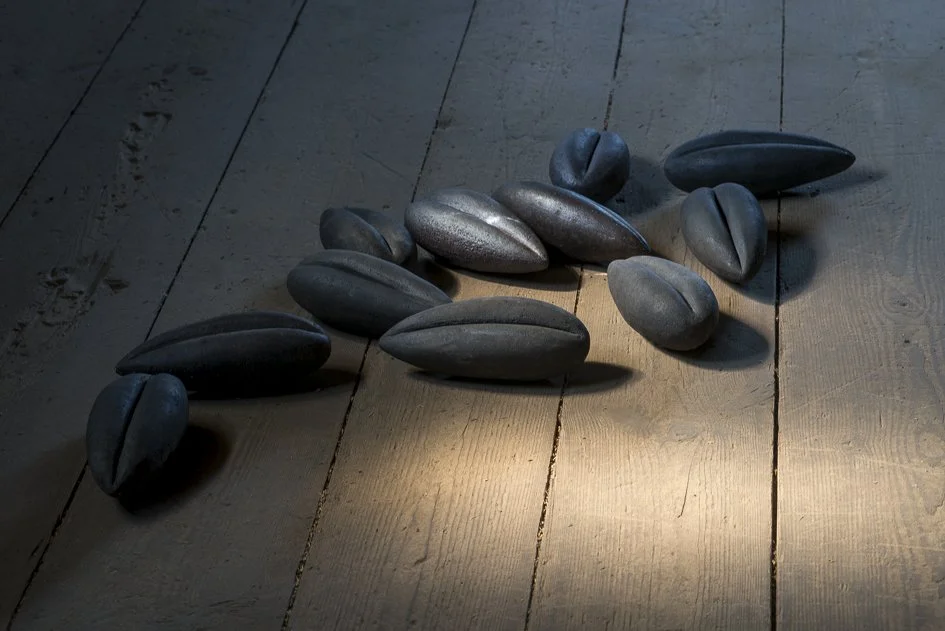
Many works of art address the problem of proximity and distance: depending on which device we use or which way round we hold it, a work may either appear vast (through a magnifying glass or under a microscope) or minute (through the wrong end of binoculars). The sculptor Alberto Giacometti solved this problem by radically paring back the physicality of his figures: from close to they convey a sense of distance and remoteness. Wolski does the opposite: he places a burning glass directly on the object, which now appears huge. We see with extreme clarity. It is as if we were given not only the blueprint of a work but also its genome. As if to prove a point, Grains (1988) consists of a handful of enlarged grains made from terracotta: Look, that’s where I’m from. As a child I often went to the lab in Dańków with my father, helped with analyzing the seeds, and spent hours counting hundreds of grains out of one container and into another. That was my first brush with infinity. But another infinity is less apparent and goes back even further; it is in a box in which Xawery’s mother Anna Branicka carefully kept beautiful little collectibles, which have barely lost their appeal, even after many years. Little things often seem large in our memories, and the substance of large things tend to turn into shadows that are less tangible, yet still palpable and even heritable.
An aura of infinity also surrounds Wolski’s immersion in different global cultures, which started with his departure from Poland in the mid-1980s, took him to Peru around a decade later, and on to Mexico, where he lived for more than twenty years. By the early 1990s his odyssey had also already taken him to the Dominican Republic and South Korea. After 2008 he spent time in Thailand, Myanmar, India, Japan, and Shanghai (2016). Over time the sculptor has thus also become an anthropologist and a naturalist. From out of the many influences on his work a “chain of beings” has emerged, which — unlike the scientific or philosophical concept of the scala naturae — is entirely non-hierarchical. What could neatly be distinguished from one another in the early 1990s as either a chain motif or an image of a human being, merged and led to new content and motifs that are never solely abstract or representational, symbolic or anthropomorphic.
The rich indigenous tradition of ceramics in South America influenced both the colossal sculpture Lungs of Barranco (1994) in Lima and White Organs (1995). They have an affinity with huacos — pre-Columbian, animal-shaped vessels — and Christian votive sculptures. Another intercontinental synthesis is seen in a small Torso (1994): the skin of its rounded little abdomen calls to mind the sensibilities of a timeless portrait, while its frontal pose is related to the archaic sculptures of ancient Greece. Most of the red-clay works Wolski made in South America have a white patina of zinc and titanium oxide. Particularly in the case of the chain motif, which he returned to in the late 1990s, this pale sun-resistant surface became a proven means of “dissolving” the form so that a feeling of infinity now resonates in the resulting lightness. The many examples of Infinity Chains — with two, three, or more links, recumbent, suspended, upright, or in the form of a Möbius strip with no beginning and no end, as in Infinitum (2007) — all speak the same language. “Infinity” is not only endlessness, a work without end like Brâncuși’s trailblazing Endless Column (1918); it is also inexhaustible.
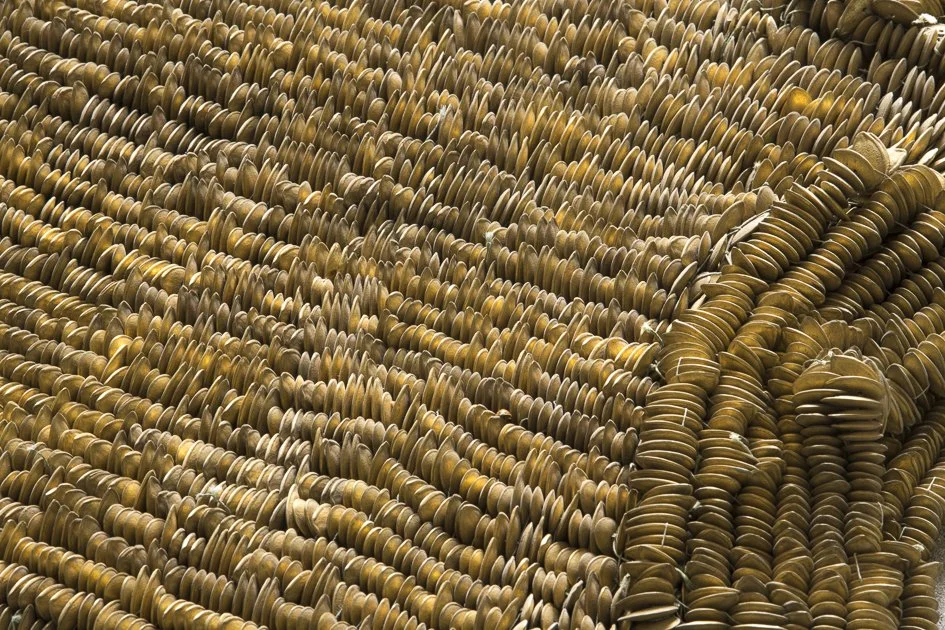
During the years that Wolski spent away from Europe, he came up with anthropomorphically charged proxies for the human body — in addition to his torsos and organs. Garments, stoles, and necklaces combine rituals and everyday life. The garments are stylized: long, slender tunics with narrow sleeves that are not really wearable. Some are hung on walls, others are suspended in space from a rod inserted horizontally through the outspread sleeves. The special thing about them is the way these faux textiles are crafted. They consist of thousands of tiny components that are threaded like beads and then interconnected to form a mesh. Diverse materials are used in these works, which — in the early 2000s — also started to introduce a whole new level of color into Wolski’s oeuvre. This collection contains items made from everyday clay (both in its natural state and colored), red seeds from the coral tree (Colorin Dress, 2008), which have traditionally been woven into bracelets in Mexico; there are also natural products and foodstuffs such as pumpkin seeds or dried bread dough. In the case of Aurum II (2013), Wolski created a garment from myriads of bronze casts of a pumpkin seed. There have already been several occasions when this object — spread out on a T-shaped plinth — rested in the choir of a church like a hybrid of heavy armor and magnificent ritual regalia.
In 2008, following Wolski’s trips to Asia, the palette of his fabrics expanded yet further. Some wall pieces, resembling paintings, demonstratively take the form of immobile blankets made from compressed waste materials that arise during silk production (Blankets, 2009); others become light chain-link hangings made from bone (Osta, 2016) or curtains of braided plant stems (Untitled, 2023). A waterfall of free-flowing loose bundles of gently swaying raw silk cascades from a pole (Silk Road, 2010), while loops of tangled skeins of wool hang from a wavering rod (Tangle, 2022).
Threading, braiding, crocheting, breathing: these are hardly the parameters of traditional sculpture. Sequencing and repetition become the basis of a meditative artistic praxis. Everything is linked to everything. Materials are labor, they are time, and they culminate in the light-footed existence of the work. In Vanishing Points (2019) the invention of focal points during the Renaissance literally disappears into thin air. An imaginary breeze blows through Progression (2010) with its sea of countless “air fruits” (invisibly suspended from the ceiling), whose components, made from loosely crocheted silvery wire, form a seemingly impenetrable cloud. As in the case of Pneuma (2020–21), which consists of a succession of “veils,” suspended in space one behind the other, viewers can select their own viewpoint for contemplating these works: either as if one were inside a house, standing behind a curtain, trying to get the best view of the street through intertwined threads. Or as if one were attempting — in vain — to catch a distant glimpse of the interior of a house with curtains from the road outside it.
Through his years of experience, working with the principles of classical sculpture, Wolski has developed a natural history of his own, which has seen him become a collector, a researcher, and ultimately a mediator. He has preserved the reverberations of nature in experimental objects such as Jackfruit (2010) and Snake Skin (2014) and has studied them in his encyclopedic artistic collection (Vitrine, 2024). His return to Dańków some years ago has allowed his oeuvre to come full circle. The extinct is honored with the extant: in Extinct (2019) from the Metamorphosis series, a small plant has put up a defense and has symbiotically coupled with an octopus. The later memorial developed from the same motif flares and burns like a butterfly bush (botanical name: Buddleia davidii). Other species, seen in Flor diente (2017) and Flor capullo (2022), are similarly universal and, as elsewhere, macroscopically overwhelming. The extensive grounds at Dańków embrace all of infinity. They easily outdo the English landscape garden as a response to the rigor and discipline of Baroque gardens. Wolski knows his own garden as thoroughly as a Renaissance scholar, Baroque garden designer, Romanticist, and scientist in one. Among the findings that the sculptor has put on display, one particularly resonates: Eco (2018), a substantial sculpture, represents an ear that has somehow[8] mutated into a calyx, playing on the different meanings of two possible pronunciations of its title in English: “echo” and “eco.” With the world in the Anthropocene apparently only belonging to human beings and merely there to be exploited, Eco’s “back from nature” is a moment of poetry that reminds us that in the long run we cannot afford to subjugate nature.
What was the question again? A kilo is a kilo. But the way we picture that kilo can vary. And the shadows? As the past they are always within us. (Once upon a time there was a palace in occupied Poland that the Branicki family was evicted from by the Germans. High up on the turrets of Wilanów Palace are two figures, who have been looking out over the Baroque gardens for the last three hundred years: two mighty Atlases, each toiling under the weight of the celestial sphere.)
Translated from the German by Fiona Elliott
Selected Literature
― Xawery Wolski: Genetyka Pamięci / Genetics of Memory, ed. Aleksandra Blonka-Drzażdżewska, Katarzyna Mieczkowska, Barbara Oratowska, and Agnieszka Rozciecha-Lis, exh. cat. Muzeum Narodowe w Lublinie, Lublin 2024. [Various texts with extensive notes by Xawery Wolski] ibid.:
― Barbara Oratowska, “Xawery Wolski — Reborn,” pp. 147–79.
― Xawery Wolski, “The Forge of Certainty,” pp. 251–52.
― “What Remains: Xawery Wolski in Conversation with Jarosław Lubiak,” in Xawery Wolski
Materialna Poetyka / Material Poetics, ed. Jarosław Lubiak, exh. cat. Orońsko: Centrum Rzeźby
Polskiej w Orońsku 2022, pp. 72–85.
― Xawery Wolski, “The Creative Process of My Art Language,” in Xawery Wolski, Milan: Skira 2020, p.178.